Friday, April 24, 2015

Busy Builders


The toddler room has been busy building with many different mediums. This study began when teachers noticed that children were very engaged in building with every material they used. They did this individually and in small groups.


One afternoon children work cooperatively to construct a fort out of the large fabric in the classroom, afterword's they enjoyed sitting together inside the fort admiring what they had done.


After the fort building teacher set up opportunities for individual children to build with different mediums, both large and small scale. During this time children built many tall, short, small, and large structures.


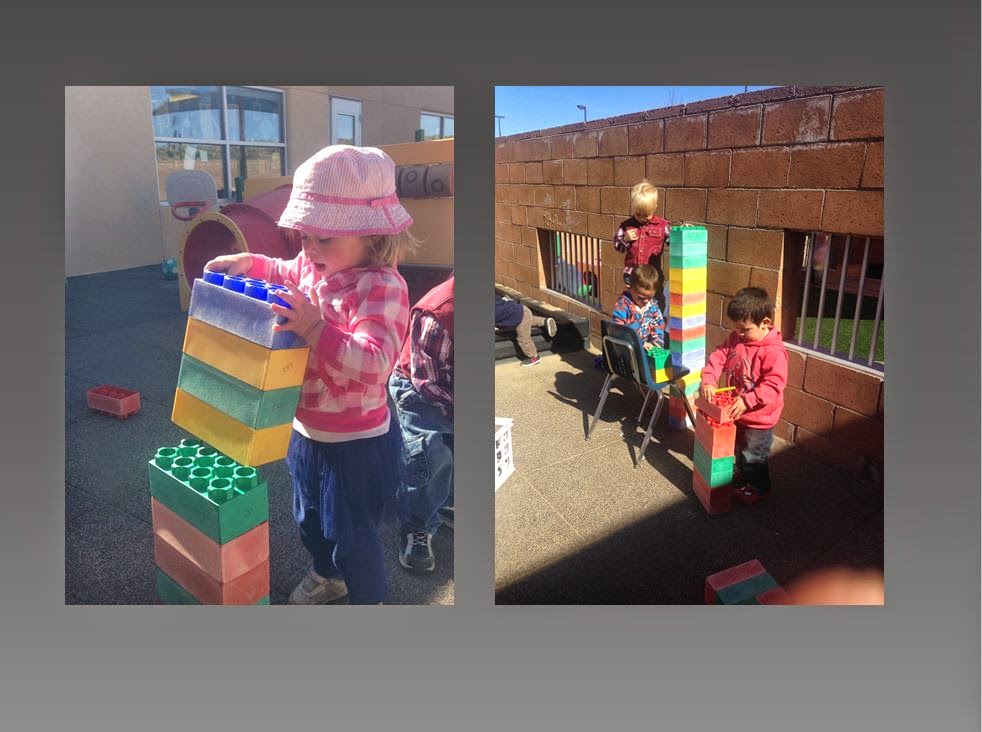
Teachers  noticed children building outside as well. During this time children worked cooperatively to build towers with large Legos. When  building outside teachers observed children being interested in how to build together but more interested in building concepts with one another especially the concept of shadow.  After this observation teachers decided to work with children in small groups in the studio to build structures and create shadows. During this time children engaged in different ways; for some it was about the act of building and putting objects inside one another, understanding how large blocks need to be on the bottom and small block on to top 


Teachers followed the natural progression of children‘s play. During this time teachers set up play opportunities that were inquiry based and an opportunity to express knowledge through creativity  expression and open ended materials.


This study of Building engaged children in all NM Early Learning Domains: Beginning to Know About Ourselves and Other, Beginning to Communicate, Beginning to Move and Do, Beginning to Build Concepts and Approaches to Learning.


Monday, March 30, 2015

Bones, Bones, Bones


Bones, Bones, Bones….. There is nothing more fascinating to our preschool students then bones! This study started when Quinn’s dad Chad brought in animal bones he had collected over the years. The preschool students closely examined each bone with magnify glasses and made predictions and discussed with one another about what animal the bone came from. 

Students also examined x-rays of animal skeletons using the overhead projector.   Teachers placed the X- Ray on the overhead projector and students and teachers would guess what animal the skeleton belonged to. Teachers then asked students how they knew it was that animal.  Here are some of their thoughts:

Avran- it is a bird because it has a beak, birds have beaks and butterflies do not

Cody- look that is a spine (as he pointed to the lizard spine) he then goes and gets a spine from the bone bucket and compares the two

Ari- that is a bird it has wings

Quin- snake, it is a snake because it is long and skinny

Elijah- (pointing at the overhead projector) this is a food bone on the bottom on the body

 
After examine the bones and looking at X-Rays children then began to express what they already know and had learned about bones through different art mediums such as clay, drawing and and popsicle stick bone representations.  During these different art projects children were very concise about which bones they were drawing and representing in their art.  Here are some of the things they said:

Troy- it the bones in your body and the blood in her hands

Ellis- Legs and spines are bones

Angelica- bones in body as she points to her legs

Gilly – these are ribs bones, they go here as she places them in the center of the skeleton

Zaria- I am making a skeleton, lots of bones

Naomi- arm bones, spine bones and leg bones as she pointed to each part of her skeleton

Ali- ribs, ribs, ribs the bones in my body

Tiana- ribs the bones in the body

After representing their body’s and bones on a small scale teachers wanted to help children do the same thing on a larger scale.  Students and teachers discussed together how they would do this. They decided they would trace each student’s body then use Popsicle sticks to represent the bones.  Throughout this study, children spent countless hours reading and learning about bones from many different books.  They also worked together and individually putting bone puzzles together.  

Margo, Diego’s mom came in and did a project with children to help them understand what bones do for our body and why it was important we take care of our bones. Each student filled a plastic glove with flour,  Margo showed the students how floppy the hand was and asked them how it could be made stronger they all screamed out bones, then students place a popsicle stick in each finger  to represent the bones in our hands . Students were amazed with how much stronger this made their hand!


New Mexico Early Learning Outcomes met during this study:

#6 the child communicates experiences, ideas, and feelings through speaking.

#11 the child demonstrates an understanding of non-standard units to measure and makes comparisons

#13 the child demonstrates appreciation for the arts

#14 the child uses the scientific methods to investigate the physical and natural worlds and to hypothesize and make predictions

#20 the child works cooperatively with other children and adults

#23 the child is open and curious to learn new things

#24 the child takes initiative

#27 the child displays persistence and pursues challenges
#28 the child uses problem-solving skills


Wednesday, March 25, 2015

Thursday, January 29, 2015

Multi-Sensory Exploration


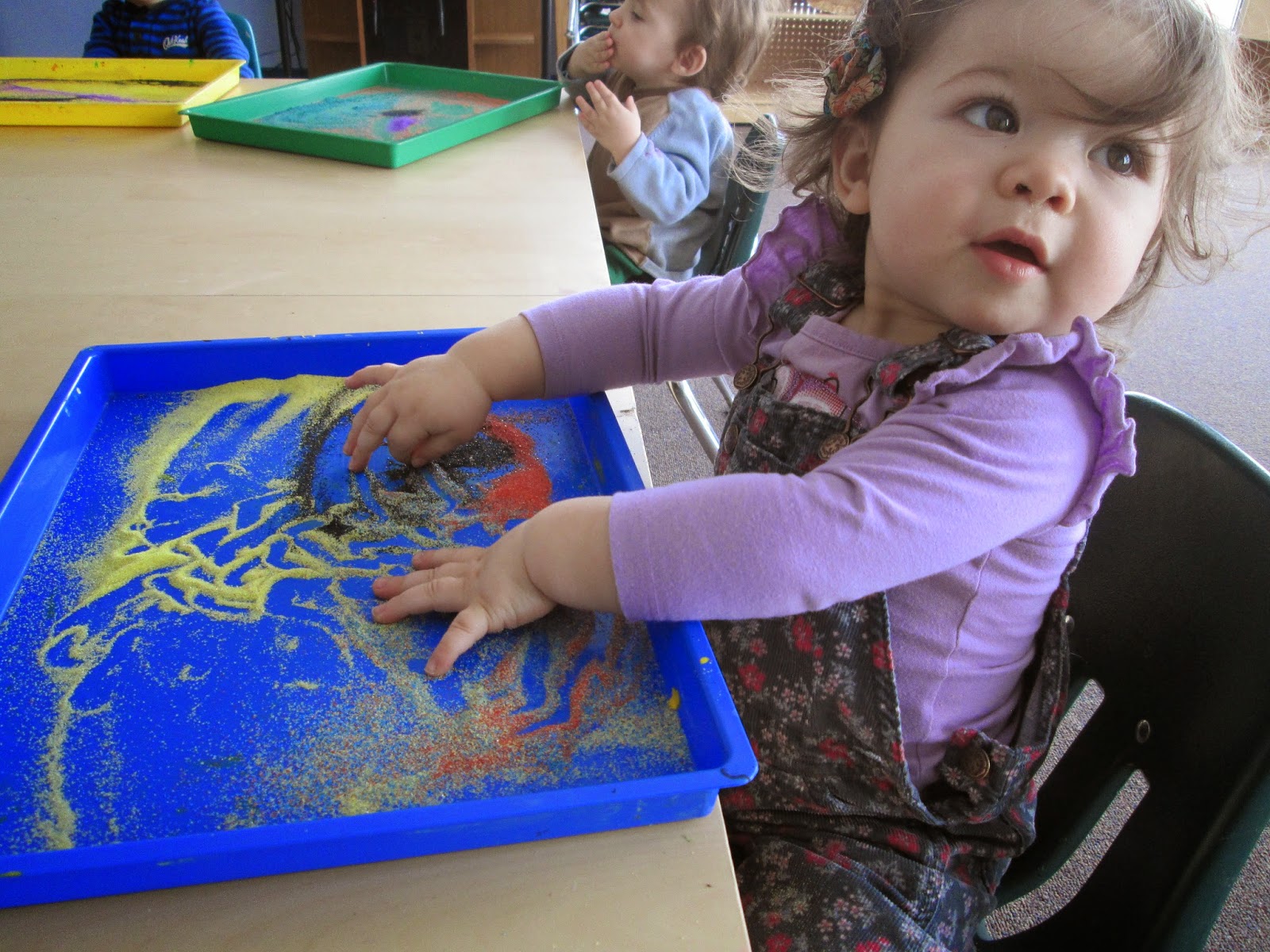
This New Year we have been exploring with a variety of sensory activities. As the children are playing with sand, water, snow, shredded paper, and paints all of their senses are at work!
Their sensory development and exposing these infants and toddlers has so many benefits for children including improvements in fine motor development, critical and creative thinking skills, and the ability to focus.
Children are using their fingers as they process each sensation they begin to categorize and classify. Exposing them to lots of different textures supports his/her sense of touch. We have provided special play areas, indoors and out, for children as they explore the surrounding world.
These types of sensory activities are engaging and most importantly help children  interact with one another and work in groups which leads to miraculously long lasting friendships with peers.


New Mexico Early Learning Guidelines met during these explorations:

Beginning to Know about Ourselves and Other

·        Infant/ toddler demonstrates an awareness of personal characteristics and abilities

·        Infant/ toddler uses beginning social skills with other children

Beginning to Communicate

·        Infant/ Toddler  responds to the message of another’s communication  

·        Infant/Toddler conveys a message to another person

Beginning to Build Concepts

·        Infant/toddler inquires about the world and experiences the properties of things

·        Infant toddler finds solutions and represents thoughts and feelings in creative ways

Approaches Toward Learning  

Infant/toddler demonstrates curiosity, initiative, persistence, imagination, and problem solving his or her everyday activities