Friday, February 14, 2014

Super Powers

Pretend play is a huge part of the preschool classroom and their lives. One theme we kept observing the children playing was Superheroes.  The children love their extraordinary powers and their vigilance in protecting civilians.  To help facilitate their imaginary play on this topic we decided to do a Superhero study!   We started off by talking with children about real and not real superheroes, what powers they had and what they did. The children came up with great ideas!
Throughout the project the children made capes, masks, armor, remote-control’s and shields. (NMELG #13 the child demonstrates appreciation for the art). 
Also during this study children read many different books about Superheroes.  After the story we asked children what the problem and the solution in the story were. As a class, children also made their own Superhero story.
(NMELG 5.4 Demonstrates understanding of new vocabulary introduced in conversation, activities, stories, and books
6.3 Engages in conversations that develop a thought idea
 7.2 Demonstrates comprehension of the story read aloud by asking relevant questions and making pertinent comments)

A large part of this study was the pretend play and role playing of the different superheroes.  Throughout the whole study children acted out different scenarios of superheroes facilitated by teachers and on their own.  One of the themes children role played were bat caves, where they made the caves out of the sleeping mats and put their blankets over them to make the cave dark. Another role that was acted out was airplane and boat sinking where superheroes had to come and save their friends.
One of the questions children had about Super Heroes was “how do they fly” to help children explore this idea, children traced their own bodies and made their own superheroes. We then set up a pulley system where children could fly their Super Heroes.

During this activity we asked children, “How is your Superhero flying”
Michelle: My superhero is flying
 Jayden:  I'm pulling it
Vincent: It going up, up, up because I am pulling it with the rope
 Jonathan: Pulling on the rope and pulling it up

Lukes:  Because it has a cape look
              Look Demitri you can hold it then Pull it
Demitri:  Pull it, pull it, pull it
 Meadow: with a string and pull it
(NMELG #14 the child uses the scientific method to investigate the physical and natural world and to hypothesize and make predictions)


Friday, February 7, 2014

Who we are ...

 
In the Infant room we build on our self help skills, which also builds on our fine motor skills.  Self help encourages autonomy and independence within our infant room. 
Early Learning Guidelines: Beginning to Move and Do: Self Help Skills: Show increasing abilities in feeding, dressing, and personal hygiene

 
We explored sponges and water...

 
First we placed the sponges on the table and an empty water table near by...

 
He showed initiative by placing the sponges into the empty water table. 

 
He continued his exploration by getting inside the water table.  Teacher asked him if he wanted to put water in the water table.  He nodded and got out of the water table.  After we placed a small amount of water into the water table, he tried sitting in the water table again.  He did not like the feeling and nonverbally communicated that he was wet.  We changed his clothes and continued our exploration...

 
We begin splashing the water with our hands, then patting the sponges. 

 
As we squeezed the water we watched the water drip from the sponge, down our arms and back into the water table. 

 
Early Learning Guidelines:
  • Approaches to Learning: Demonstrate curiosity by using all senses to explore new things in the environment; Demonstrate preferences and make independent choices; Demonstrate more complex problem solving skills
  • Beginning to Move and Do: Fine Motor: Use hands and fingers in more complex and refined ways


In the Infant Room we are building relationships with others and with self.  We are learning and practicing empathy, compassion, and sharing.  We learn and practice while keeping an understanding of developmental milestones. 

 
Sometimes we share ...

 
Sometimes we laugh ...
 

Sometimes we cry ...
 
All those emotions are ok.  And acknowledging those emotions help to build our relationships, empathy, compassion ... 
 

Wednesday, February 5, 2014

Taos Mountain With Black Ink and Water Color


January 27, 2014 

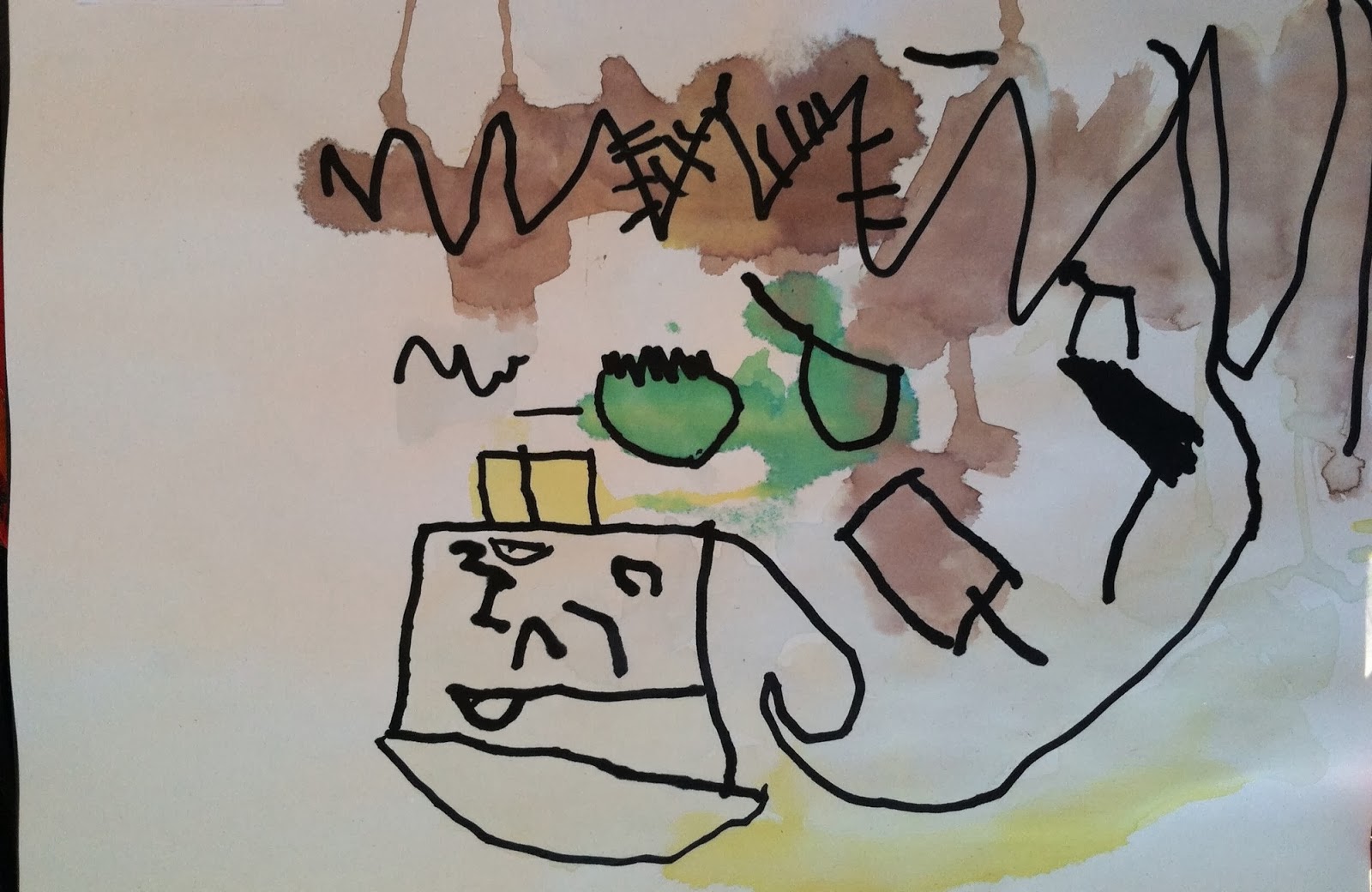
When teachers were thinking about a gift to give to Lella Gandini an educator from Reggio Emilia Italy who is visiting New Mexico, we all wanted to give her something that would best represent who we are as a school and as a community.  All of us agreed that Taos Mountain somehow had to be incorporated. Taos Mountain is the icon of Taos and is more than just a land mass to both students and teachers.  It is very much a part of our lives, community and livelihood of our small mountain town.

We chose to have our New Mexico Pre-K class represent Taos Mountain through black ink and water color drawings. We first discussed the components of a water color done by a local artist Ann Honston. The students discussed what they saw in the painting and compared it to the landscape they saw through the window.  Students then worked with permanent markers to outline their landscape then filled in with watercolors.

What does Taos Mountain mean to you?

 EmmaSofia : That you can ski and that you have to drive way up there.

                        Taos sunset is what I did on my painting.

Max:  There are clouds way up there sometimes the mountain is higher than the clouds.

Adam: It’s a special place and a place to ski.

Carly: I see snow and I like snow.

           My house has a heart on it because there is love.

Aliya: We went up the hill and there was snow on the mountain, dirt water and lots of rocks.

Noah: Different animals live up there like elk and bears.

Ava: Camping, fun, trees, snow, and hiking trails.

         I think of my grandma because she lives up in Taos mountain.

         It’s a magic mountain!


Pre-K Explores Signs


January 6, 2014

The children in the pre-k class have been studying buildings, homes and other types of structures for several weeks. This study has also moved their interests into road signs and other types of signs that they see throughout the community.

We went for a walk around the campus and took several pictures of signs, printed them out and set them out on tables for the children to look at, discuss and create on their own. They used a variety of materials including; paper, markers, cardboard, paints, and other materials.

As we walked and in the classroom for many days afterward,, we discussed with the children what the signs meant, even though some of them had no words. We asked them what they thought the signs said and got many responses such as; stop, go this way, people walking, and rules that people have to follow. They also noticed that many of the signs had letters of their names, we counted the letters of children’s names, the sounds they made and the many different shapes of the signs we saw.

We asked them to look for signs as they drove or walked around the community, and many came back and reported that they had seen signs at stores, offices, and on the side of the road as well. We also discussed that many signs have information for people, such things they can buy or places to go.


Building with one another


This week we will also continue to incorporate emotion words into our daily conversations as we are continuously observing our children experiencing many different emotions (developmental). As we are reading books we are pointing to pictures of children faces (happy, sad, etc..) When a child in the classroom is having a difficult time with transitions we acknowledge their emotions and support them through their growing emotions. Building with cardboard and glue added to our fine motor exploration. Two of the children used their hands and fingers to explore, pinch, squeeze and to use new tools to accomplish goals. We also built with pegs and magnets. Along with using our fine motor skills to meet and accomplish goals, we also used our gross motor skills. We practiced coordination and balance by playing on the climbing structure. We practiced walking as we used the walker and attempted steps (with and without teacher support). On Wednesday two children were able to interact with one another as we explored the magnets during lunchtime and on buggy rides.
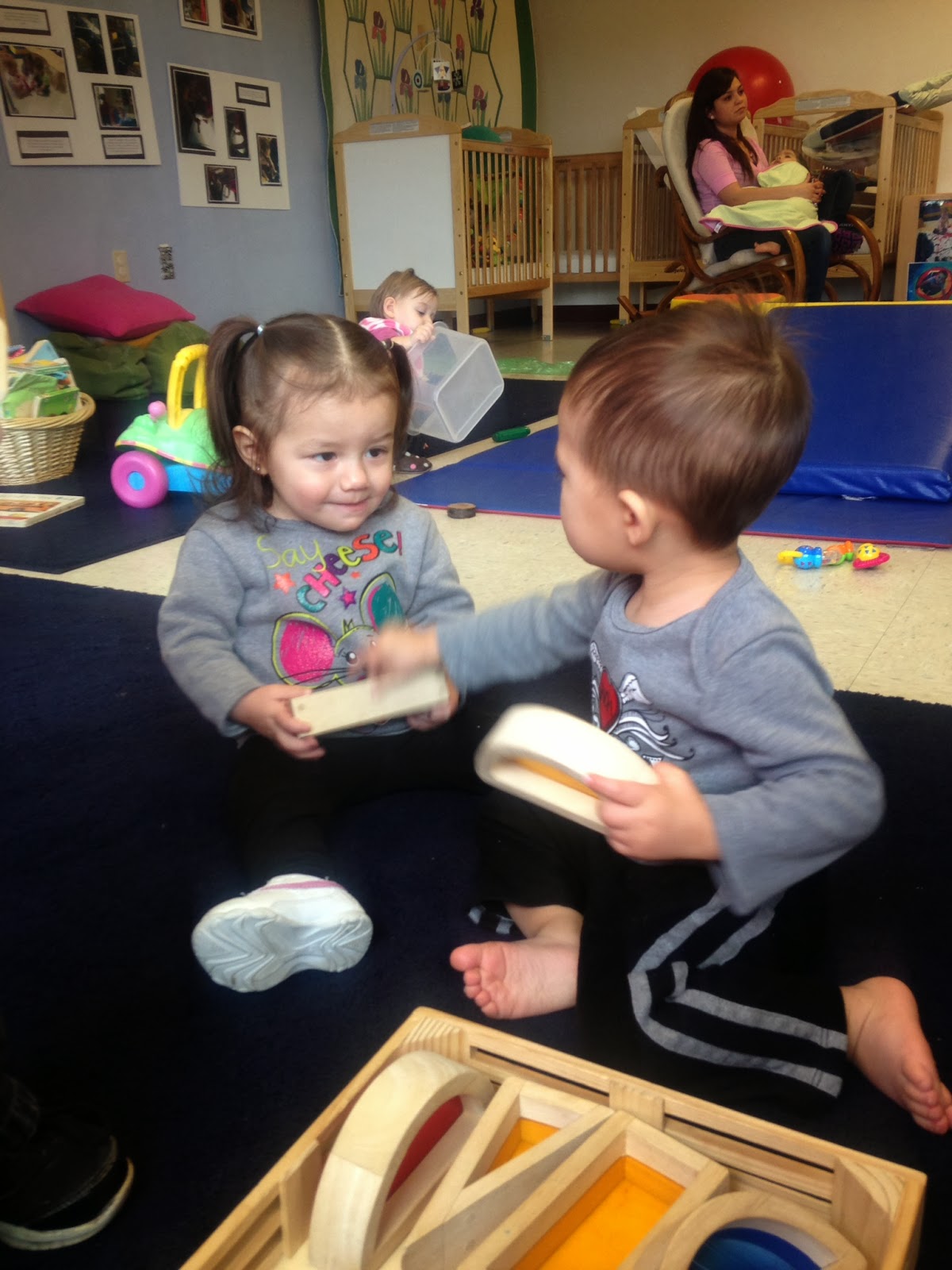
We will… This week will explore water and sponges. As the children are playing with water and the sponge all of their senses are at work. They are learning, processing, and categorizing. Children are using their fingers to touch the water and squeeze the sponge. They are able to watch how the water drips, splashes, and moves. As they processes each sensation (sound, sight, feeling, taste), they begin to categorize and classify.